
Install Claude Desktop on Ubuntu
Three steps, five minutes. This needs Ubuntu 22.04 or later, because the package wants a version of the C library that Ubuntu 20.04 does not have.
The same install on a Linux desktop, followed by the Cowork fix covered further down this page.
Installing Without the Repository
Most readers should skip this section. It is for the two situations where the repository route is not available: a machine whose network blocks the repository, and a machine where policy says no third-party apt sources.
The package itself still comes from the same place. This command reads the repository index, finds the newest package for your architecture, and downloads just that file into the current folder:
Then install it from the folder it landed in:
mike@ubuntu:~$ sudo apt install ./claude-desktop_*.debInstalling the file still adds the repository. The package registers /etc/apt/sources.list.d/claude-desktop.list on its own, which is exactly what you want if you only took this route because a download was easier, and exactly what you do not want if the whole point was to avoid the repository.
To stop that, create /etc/default/claude-desktop containing the line CLAUDE_DESKTOP_ADD_REPO="false" before you install. The trade is that nothing will ever update the app again: you repeat the download by hand, or you add the repository later and go back to normal.
Sign In and What You Need
Sign in with your Claude account, or with your organisation’s single sign-on. It is the same account you use on the web, and your conversations follow you between them.
What will not work is an API key from the Claude Console. This is worth saying plainly because the people most likely to install a desktop app on Ubuntu are often the same people who already have an API key in a terminal somewhere, and it is a reasonable guess that the app would take one. It does not. If billing through the API is what you want, that is the command-line tool’s job, not this app’s.
The app costs nothing to install. What you can do inside it follows whatever Claude plan your account is on, exactly as it does on the web, and there is no separate charge or separate tier for Linux.
What the App Does
This is not the website in a window. It is the same application Anthropic ships on macOS and Windows, with three things in it: ordinary chat, Claude Code for working in your repositories, and Cowork for longer jobs you hand over and come back to.
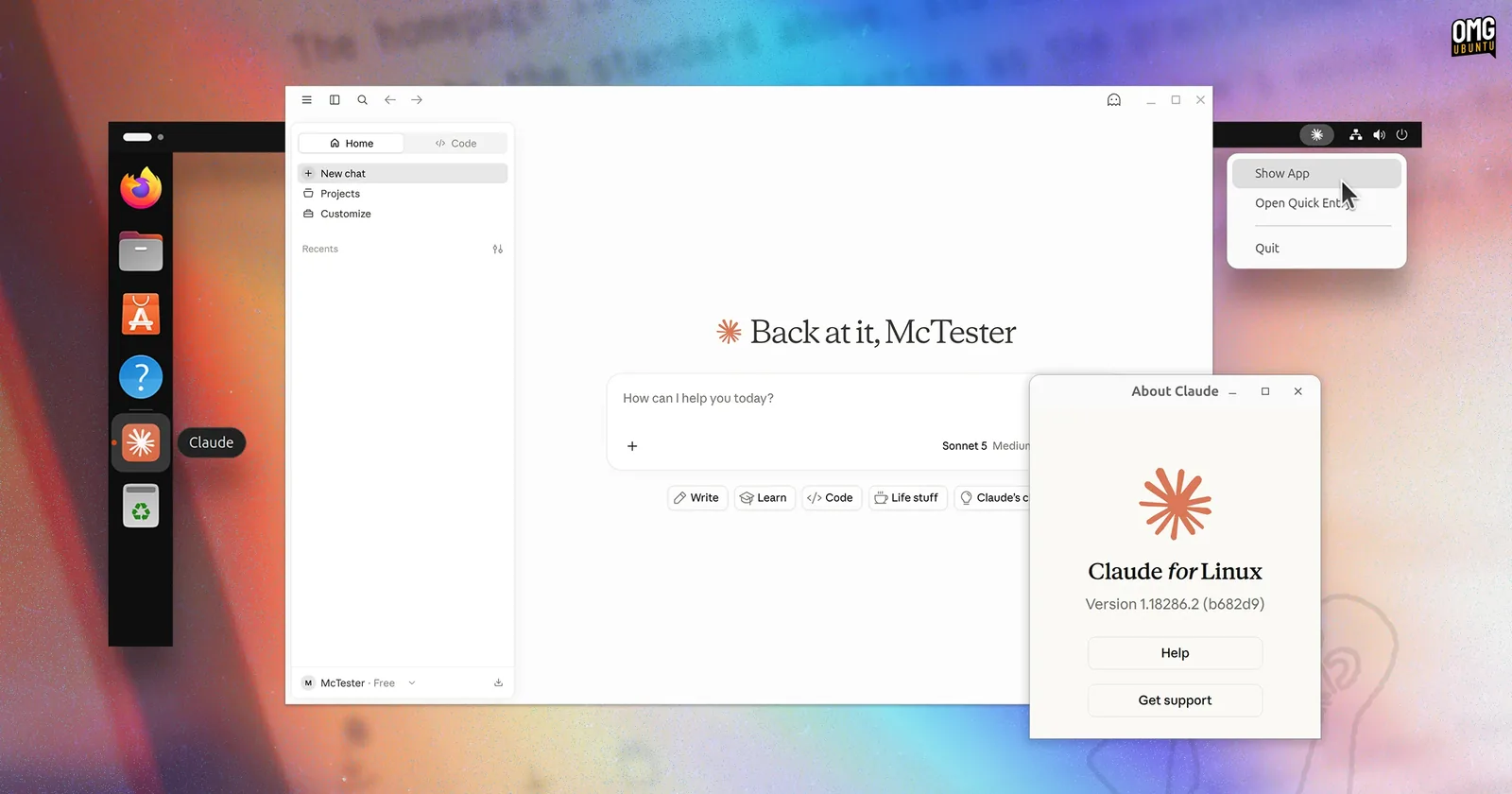
Two things in that picture are worth pointing at. The tray icon is a real desktop integration, not a window that vanishes when you close it: Show App brings it back and Quick Entry opens a small box you can type into without hunting for the window. And the app knows what build it is, which matters more than usual here, because on Linux you do not update it yourself and the version number is how you check that apt has been doing its job.
Inside, the parts a developer will care about are the ones borrowed from Claude Code: several sessions at once, changes shown as a diff you approve or reject rather than applied behind your back, a terminal and an editor in the same window, and a live preview of whatever you are building. Everything you type is answered by Anthropic’s servers. Nothing in this app runs a model on your own machine, and a file it reads is a file that is sent.
Cowork Runs in a Virtual Machine
On Linux, Cowork starts a virtual machine on your computer and does its work inside that. This is the part of the app with real requirements, and it is why a chat application pulled in QEMU during the install.
The reason is straightforward once you see it. Cowork is for jobs you hand over and walk away from, where Claude runs commands and edits files for a while without you watching each step. Doing that directly on your desktop means an agent with your permissions and your home directory. Doing it in a virtual machine means a boundary you did not have to build, with only the folders you share crossing it. The QEMU packages are not an optional extra, they are the wall.
Four things have to be true before the tab will open.
One, hardware virtualization has to be turned on in your firmware. On most machines bought in the last decade it already is. On some it is off by default, and it is called Intel VT-x, AMD-V or sometimes just “virtualization” in the firmware settings you reach by holding a key at boot.
Two, the QEMU packages have to be present, and which ones depends on your architecture:
| Architecture | Packages Cowork needs |
|---|---|
| x86_64, which apt calls amd64 | qemu-system-x86, ovmf, virtiofsd |
| arm64 | qemu-system-arm, qemu-efi-aarch64, virtiofsd |
A normal apt install claude-desktop brings these in as recommended packages, so on an ordinary desktop install they are already there. On Ubuntu 22.04 there is no virtiofsd package at all, and the app carries its own copy for that case, so nothing is missing on 22.04 even though the package list looks short.
Three, your user has to be in the kvm group. This is the requirement most likely to bite, because it looks satisfied when it is not:
Then log out and back in. Group membership is decided when you log in, so the change does nothing until you do. And join the group even if you already have access to /dev/kvm: some desktop environments hand the logged-in user that one device without the group, but Cowork also opens /dev/vhost-vsock, and only members of the group can open that.
Four, the vhost_vsock kernel module has to be loaded, which is what lets the app talk to the machine it started. Load it now, and tell the system to load it at every boot:
The app checks all four of these once, when it starts. Installing a package or joining a group while it is open changes nothing on screen. Close it and open it again after installing anything, and log out and back in after joining the group. A grey Cowork tab that you have already fixed is almost always an app that has not been restarted.
When Cowork Will Not Start
The Cowork tab tells you which requirement it is missing. Each message below is the app’s own wording, so match yours to the heading and take the fix under it. Restart the app afterwards in every case.
Other Things That Go Wrong
How Updates Reach You
You do not update this app, and it does not update itself. There is no updater inside it on Linux, no “a new version is available” box, and nothing to download when a new build ships. Your system brings it, along with everything else.
mike@ubuntu:~$ sudo apt update && sudo apt upgradeUbuntu’s own Software Updater picks it up too, so if you already let that run there is genuinely nothing to do. This is the reason the repository route is worth the extra two commands over downloading a file: with the repository, a newer version is a thing that happens to you. Without it, it is a thing you have to remember.
If you want to know what you are running, the About dialog in the tray menu names the build, and apt will tell you the same thing:
mike@ubuntu:~$ apt policy claude-desktopRemove It Cleanly
Removing the app is one command, and then one judgement call about the repository.
That takes the repository entry and key the package registered with it. Which sounds like the end of it, and on one of the two install routes it is. Here is the part that catches people, and it depends on how you installed:
If you installed the .deb directly, the package added the repository itself, so removing the package takes it away again. You are finished.
If you followed the steps at the top of this page, you wrote that source file yourself, and nothing written by hand is removed by apt. It is still there, still being checked every time you update, pointing at an app you no longer have. Take it out yourself:
That second command is the proof, and a missing file is the answer you want. Nothing you wrote in the app is stored on your machine, so none of this deletes a conversation. They live in your Claude account and removing the app does not touch them.
One optional tidy-up. If you never use QEMU for anything else, the virtual machine packages that came in with the app are still installed, and sudo apt autoremove will offer to take them. Read what it lists before agreeing. If you run virtual machines by any other means, you want to keep them.
Helpful Resources
Frequently Asked Questions
Is Claude Desktop free to install on Ubuntu?
The app costs nothing to install and there is no separate charge or separate tier for the Linux version. What you can do inside it depends on the Claude plan your account is on, exactly as it does on the web, so the app is not the thing that decides what you get. You do need an account: there is no way to use it signed out.
Does it work offline, or run a model on my own machine?
No to both. Every message is sent to Anthropic’s servers and answered there, so the app does nothing at all without an internet connection, and anything it reads on your machine is sent along with your question. The virtual machine that Cowork runs is a boundary around what Claude is allowed to touch on your computer, not a model running locally. If running a model on your own hardware is what you want, that is a different kind of tool entirely.
Is the Linux app finished, or should I wait?
The Linux version arrived in June 2026 with a beta label, and what that has meant in practice is an app that works for daily use with three gaps against macOS and Windows: Computer Use, dictation, and a Quick Entry shortcut that needs help on Wayland. All three are covered in this guide and none of them stops you chatting, writing code or using Cowork. Because it installs through apt, waiting buys you nothing anyway: whatever improves arrives on your machine with your normal system updates whether you installed today or next month.
Can it control my desktop the way it does on Mac and Windows?
Not on Linux. Computer Use, where Claude clicks and types in your other applications, is a macOS and Windows feature, and voice dictation is missing for the same reason. What Linux has instead is the part most people install this for: chat, Claude Code working inside your own repositories with changes shown as a diff you approve, and Cowork for longer jobs.
Why does Cowork need a virtual machine on Linux?
Cowork is for work you hand over and leave running, which means Claude executing commands and changing files without you approving each one. Running that directly on your desktop would give it your permissions and your home directory. Running it inside a virtual machine that the app starts with QEMU and KVM puts a boundary around it, and only the folders you share cross that boundary. This is why installing a chat application also installs QEMU, and why the Cowork tab has requirements the rest of the app does not.
Which Ubuntu versions does it support?
Ubuntu 22.04 and later, which covers 26.04, 24.04 and 22.04, plus Debian 12 and later. Ubuntu 20.04 genuinely cannot run it: the package needs a newer C library than 20.04 ships and apt says so rather than installing something broken. Other Debian-based distributions that are new enough usually work but are not tested. On Fedora, RHEL or Arch there is no desktop package at all, and the command-line version of Claude Code is the supported route.
Anthropic’s own desktop app for Ubuntu and Debian, on x86_64 and arm64, from a signed repository.
Related guides: Install ChatGPT on Ubuntu · Install Visual Studio Code on Ubuntu · More AI guides for Ubuntu