
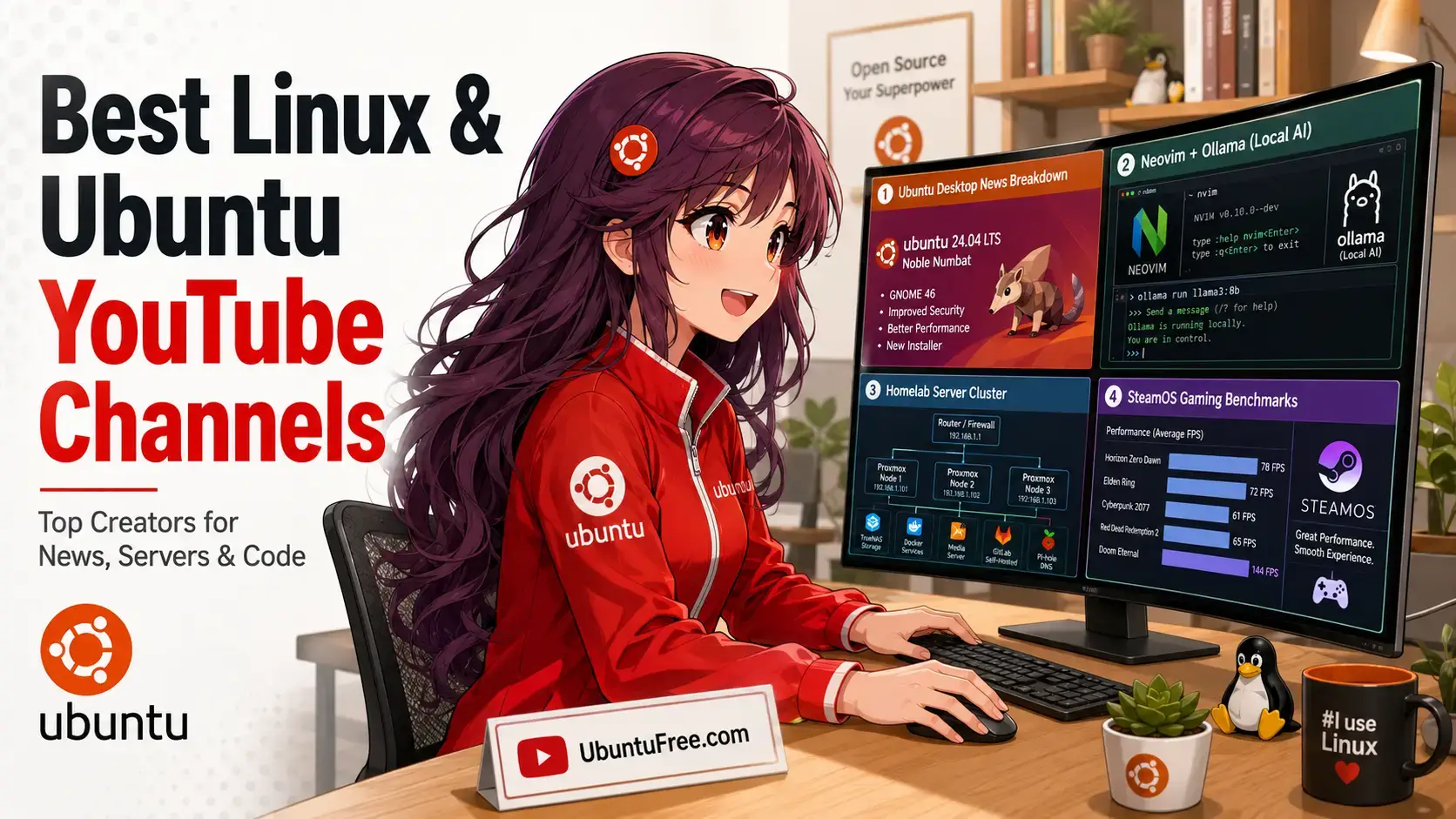
 The best Linux YouTube channels include Learn Linux TV for structured server courses, The Linux Experiment for weekly desktop news and updates, and Dreams of Code for terminal tools and local AI workflows.
Whether you are switching from Windows, building a home server, or looking for practical desktop tips, these creators make learning Linux and Ubuntu easy and straightforward.
This guide highlights the top active Linux YouTube channels categorized by desktop news, home server labs, PC gaming, and AI developer tools.
For additional resources, explore our directory of the best Linux websites and links. Let us know your favorite in the comments below.
🏅 Top YouTube Picks at a Glance
- Best for Beginners & News: The Linux Experiment – Weekly open-source news, desktop reviews, and privacy updates.
- Best for Ubuntu Server & Admin: Learn Linux TV – Complete step-by-step courses on Ubuntu server labs, SSH, and Ansible.
- Best for Homelab & Docker: NetworkChuck – High-energy tutorials on Docker containers, networking, and home servers.
- Best for Terminal & Local AI (Trending): Dreams of Code – Modern terminal workflows, local AI assistant integration via Ollama, and CLI utilities.
- Best for Linux Gaming & Handhelds: Retro Game Corps – Comprehensive guides for SteamOS, Bazzite, and handheld Linux setups.
📌 Table of Contents – Quick Category Jump
📰 Category 1: Linux News, Distros & Desktop Trends
These channels focus on desktop Linux developments, major distribution releases like Ubuntu and Fedora, application reviews, and open-source software news. They are ideal for users who want to stay informed about desktop Linux without getting bogged down in complex terminal configurations.
Weekly News & Reviews
Target Audience: Desktop beginners, Linux switchers, and open-source enthusiasts seeking structured news and distro reviews.
Why Subscribe? Hosted by Nick, The Linux Experiment is widely regarded as the most accessible weekly news digest in the Linux community. The channel breaks down distribution updates (Ubuntu LTS, Fedora, Linux Mint), GNOME and KDE Plasma developments, and open-source privacy topics into objective, polished videos.
- Key Topics: Ubuntu release breakdowns, GNOME desktop features, open-source app showcases, privacy tools.
- Standout Feature: Professional, calm delivery without clickbait, focusing on real-world desktop usability.
Multi-Weekly
Target Audience: Intermediate users, custom desktop configuration fans, and command-line enthusiasts.
Why Subscribe? Derek Taylor (DT) delivers hands-on tutorials covering tiling window managers (i3, XMonad, QTile), shell scripting, Emacs, Vim, and open-source software licensing. DistroTube is a staple channel for learning how to strip away graphical desktop bloat and configure a personalized Linux environment.
- Key Topics: Arch Linux setups, shell config files (dotfiles), terminal utilities, open-source philosophy.
- Standout Feature: Unfiltered live terminal coding and step-by-step configuration file walkthroughs.
Weekly Tutorials
Target Audience: Windows switchers, system administrators, and performance optimization seekers.
Why Subscribe? Chris Titus provides practical guides for users switching from Windows to Ubuntu or Debian. As a former enterprise IT director, Chris focuses on utility-first scripts, disk management, kernel tuning, and real-world system maintenance.
- Key Topics: Ubuntu desktop tuning, custom system scripts, Windows-to-Linux migration guides.
- Standout Feature: Maintains popular open-source system optimization scripts directly on GitHub.
Daily / Multi-Weekly
Target Audience: Intermediate developers, open-source news followers, and software licensing analysts.
Why Subscribe? Brodie Robertson offers rapid, detailed commentary on open-source software news, package manager changes, desktop display technology, and software licensing updates. It is the go-to channel for hearing practical developer perspectives on current Linux news.
- Key Topics: Desktop display features, Flatpak app updates, Linux kernel releases, open-source discussions.
- Standout Feature: Fast turnaround time on breaking open-source technology news.
Bi-Weekly
Target Audience: Desktop Linux users, Steam Deck owners, and hardware enthusiasts.
Why Subscribe? Gardiner Bryant creates clean, engaging videos focused on desktop Linux hardware, operating system comparisons, and open-source gaming. Gardiner provides honest reviews of Linux laptops, Steam Deck accessories, and desktop distribution releases.
- Key Topics: Linux laptops, hardware compatibility, Steam OS updates, desktop Linux guides.
- Standout Feature: High production quality with a strong emphasis on consumer hardware usability.
⚙️ Category 2: SysAdmin, DevOps & Ubuntu Server Automation
If you want to run an Ubuntu home server, deploy Docker containers, automate deployments with Ansible, or build Kubernetes clusters, these creators offer structured, production-grade education.
Multi-Weekly Courses
Target Audience: Ubuntu Server administrators, DevOps engineers, and students preparing for Linux certifications.
Why Subscribe? Jay LaCroix has built Learn Linux TV into the single most comprehensive training resource for Ubuntu Server on YouTube. The channel features full multi-hour courses on Ubuntu Server LTS installation, SSH hardening, Proxmox virtualization, Ansible automation, and ZFS storage arrays.
- Key Topics: Ubuntu Server LTS guides, SSH security, Proxmox hypervisors, Ansible automation.
- Standout Feature: Free, full-length structured courses with zero missing steps.
Weekly Labs
Target Audience: Beginners and IT professionals looking for high-energy hands-on labs in Linux, Docker, and networking.
Why Subscribe? NetworkChuck combines high energy with practical hands-on labs. Chuck breaks down complex server concepts – such as setting up Docker containers on Ubuntu, configuring WireGuard VPNs, and mastering Python automation – into fun, fast-paced projects.
- Key Topics: Docker container labs, Ubuntu networking, Raspberry Pi projects, cloud security.
- Standout Feature: Engaging, lab-first teaching format that gets viewers building immediately.
Weekly DevOps
Target Audience: DevOps engineers, homelab builders, and Infrastructure-as-Code enthusiasts.
Why Subscribe? Christian Lempa bridges the gap between traditional Linux server setups and automated cloud hosting. His videos focus on deploying self-hosted apps using Docker Compose, automated server building tools, and local home server clusters.
- Key Topics: Docker Compose stacks, local DNS hosting, GitOps pipelines, Proxmox virtualization.
- Standout Feature: Extremely clean architectural diagrams and production-ready code repositories.
Weekly Homelab
Target Audience: Home server administrators, cluster engineers, and self-hosting power users.
Why Subscribe? Techno Tim specializes in high-availability homelab setups, TrueNAS Scale storage, Tailscale networking, and physical server hardware builds. His guides show how to build enterprise-grade cloud capabilities at home on Linux.
- Key Topics: Kubernetes homelab clusters, TrueNAS Scale, Tailscale tunnels, hardware assembly.
- Standout Feature: Fully documented GitHub repositories allowing one-click replication of cluster setups.
Weekly DevOps
Target Audience: DevOps engineers, software developers, and cloud platform candidates.
Why Subscribe? Nana Janashia provides world-class animated breakdowns of complex cloud-native architectures. If you want to understand how Linux underpins Docker, Kubernetes, CI/CD pipelines, and cloud infrastructure, this channel is an essential reference.
- Key Topics: Kubernetes administration, Docker Buildx pipelines, GitHub Actions, cloud architecture.
- Standout Feature: Animated visual diagrams that simplify enterprise-scale Linux concepts.
🎮 Category 3: Homelabbing, Hardware & Linux Gaming
Thanks to Valve’s Proton translation layer and handheld hardware like the Steam Deck, Linux gaming and custom hardware setups are thriving. These channels provide benchmarks, hardware mods, and retro gaming guides on Linux.
Weekly Projects
Target Audience: Hardware hackers, Raspberry Pi enthusiasts, and Ansible automation engineers.
Why Subscribe? Jeff Geerling is famous for pushing Raspberry Pi boards, PCIe expansions, and Linux bare-metal server clusters to their absolute physical limits. Jeff also authored foundational books on Ansible automation on Linux.
- Key Topics: Raspberry Pi 5 clusters, Ansible playbooks, Linux kernel storage limits, ARM architecture.
- Standout Feature: Creative hardware testing combined with production-grade Ansible automation scripts.
Weekly Guides
Target Audience: Handheld gaming fans, emulation customizers, and low-footprint Linux users.
Why Subscribe? Russ at Retro Game Corps produces meticulous guides on configuring Linux-based gaming operating systems like Bazzite, ROCKNIX, and SteamOS. His written and video guides demystify storage setups, frontend configuration, and emulator performance tuning on Linux.
- Key Topics: Bazzite, SteamOS optimization, handheld gaming PCs, retro Linux emulation.
- Standout Feature: Exceptionally detailed written companion guides alongside calm, thorough videos.
Weekly Benchmarks
Target Audience: Performance analysts, translation layer engineers, and hardware testing enthusiasts.
Why Subscribe? The Phawx focuses heavily on deep technical analysis of PC gaming performance on Linux, Steam Deck battery tuning, graphics drivers, and gaming compatibility tools. If you want clear frame rate charts and detailed battery benchmarks, this channel leads the field.
- Key Topics: Game compatibility tools, graphics drivers, battery tuning, SteamOS performance benchmarks.
- Standout Feature: Rigorous, data-driven hardware testing under extreme workloads.
Bi-Weekly Guides
Target Audience: Desktop customizers, retro computing fans, and Bash command learners.
Why Subscribe? Veronica combines clear technical explanations with hardware retrocomputing and customization. Her videos walk through terminal fundamentals, file system mechanics, single-board computer projects, and practical scripting in an entertaining, accessible style.
- Key Topics: Bash scripting, local storage management, single-board computers, desktop customization.
- Standout Feature: Engaging storytelling that makes foundational Linux mechanics feel fun and effortless.
Weekly Discussions
Target Audience: Daily-driver desktop users, window manager designers, and community discussion fans.
Why Subscribe? The Linux Cast focuses on authentic daily-driver Linux usage, evaluating window managers (i3, Hyprland), long-term operating system reviews (Ubuntu, Arch, Bluefin), and self-hosted application alternatives.
- Key Topics: Tiling window managers, daily desktop workflows, open-source software reviews.
- Standout Feature: Realistic, community-focused troubleshooting from an everyday desktop user’s perspective.
🧠 Category 4: Linux Coding, AI Workflows & Terminal Mastery
Modern Linux software development is turning toward keyboard-driven terminal environments, modal editors like Neovim, and running local AI assistants (Ollama) directly on Linux workstations.
Daily Programming
Target Audience: Software engineers, backend developers, and terminal modal editing fans.
Why Subscribe? ThePrimeagen (The PrimeTime) is a driving force in terminal-first software development. The channel focuses on Neovim configuration, Rust and Go backend development, memory performance tuning, and high-speed developer workflows on Linux.
- Key Topics: Neovim setup, Go and Rust performance, terminal editing speed, system architecture.
- Standout Feature: High-energy live-coding sessions pushing keyboard-only productivity.
Bi-Weekly Tutorials
Target Audience: Modern terminal developers, local AI enthusiasts, and microservice builders.
Why Subscribe? Dreams of Code produces crisp, minimalist tutorials on modern terminal utilities (tmux, lazygit, zoxide), running local AI assistants with Ollama on Linux workstations, and building high-performance backend tools in Go and Rust.
- Key Topics: Local AI runners (Ollama), terminal multiplexers (tmux), CLI utilities, Rust microservices.
- Standout Feature: Clean, highly focused presentation that delivers practical code setups without fluff.
Weekly Code
Target Audience: Junior to intermediate developers constructing custom Neovim configurations.
Why Subscribe? Typecraft is widely acclaimed for its step-by-step series on building custom Neovim configurations from scratch using Lua. The channel also covers shell scripting, terminal utilities, and modern web application development on Linux.
- Key Topics: Neovim Lua setup, LazyGit terminal interfaces, Linux terminal scripting, web development.
- Standout Feature: Clear incremental teaching style that turns complex editor configs into easy modules.
Monthly Coding
Target Audience: Web developers, aesthetic terminal customizers, and full-stack software engineers.
Why Subscribe? Created by Takuya Matsuyama, devaslife delivers immersive, aesthetic live-coding sessions showing how a veteran developer builds full-stack React and TypeScript applications using a customized Linux terminal and Neovim workflow.
- Key Topics: Modular Neovim configs, React/TypeScript on Linux, aesthetic desktop setups.
- Standout Feature: Ultra-polished ASMR-style production showcasing real production app development.
Weekly Systems
Target Audience: Systems programmers, cybersecurity students, and C/Linux kernel developers.
Why Subscribe? Low Level Learning teaches lower-level computer science, C programming, Linux system calls, memory safety, and reverse engineering. It is ideal for developers who want to understand how the Linux kernel interfaces directly with hardware.
- Key Topics: C programming, Linux kernel internals, memory management, reverse engineering.
- Standout Feature: Humorous, fast-paced lessons on low-level systems programming concepts.
Weekly Hardware
Target Audience: Hardware hobbyists, single-board computer fans, and Linux OS learners.
Why Subscribe? Christopher Barnatt provides calm, expert hardware reviews, single-board computer testing (Raspberry Pi, Orange Pi), Linux OS distro reviews, and local AI hardware benchmarks on Linux.
- Key Topics: Single-board computers, Linux distro reviews, local AI hardware testing, hardware modding.
- Standout Feature: Extremely thorough, methodical hardware teardowns and Linux performance testing.
❓ Frequently Asked Questions
What is the best YouTube channel for learning Ubuntu for beginners?
Learn Linux TV and The Linux Experiment are the two best starting channels. Learn Linux TV provides structured courses on Ubuntu desktop and server basics. The Linux Experiment delivers weekly updates on desktop Linux features and application reviews in plain language.
Which YouTube channel is best for learning Linux server administration and DevOps?
Learn Linux TV, NetworkChuck, and TechWorld with Nana are top choices for server administration. Learn Linux TV covers production Ubuntu server setups and SSH security. NetworkChuck specializes in Docker and networking labs, while TechWorld with Nana focuses on Kubernetes and CI/CD pipelines.
Where can I find YouTube tutorials on running local AI on Linux?
Dreams of Code, The PrimeTime, and ExplainingComputers regularly cover running local AI models on Linux using tools like Ollama, Open WebUI, and terminal integrations.
What YouTube channels cover Linux gaming and Steam Deck performance?
Retro Game Corps and The Phawx are leading creators for Linux gaming. They provide detailed benchmarks for SteamOS, Bazzite, Proton compatibility layers, and handheld hardware tuning.
Are there Linux YouTube channels focused purely on terminal editors like Neovim?
Yes. Typecraft, devaslife, and The PrimeTime focus heavily on configuring Neovim, terminal multiplexers like tmux, LazyGit, and building keyboard-only development setups on Linux.
Don’t forget to check out our list of the best Linux Podcasts to listen to right now.