

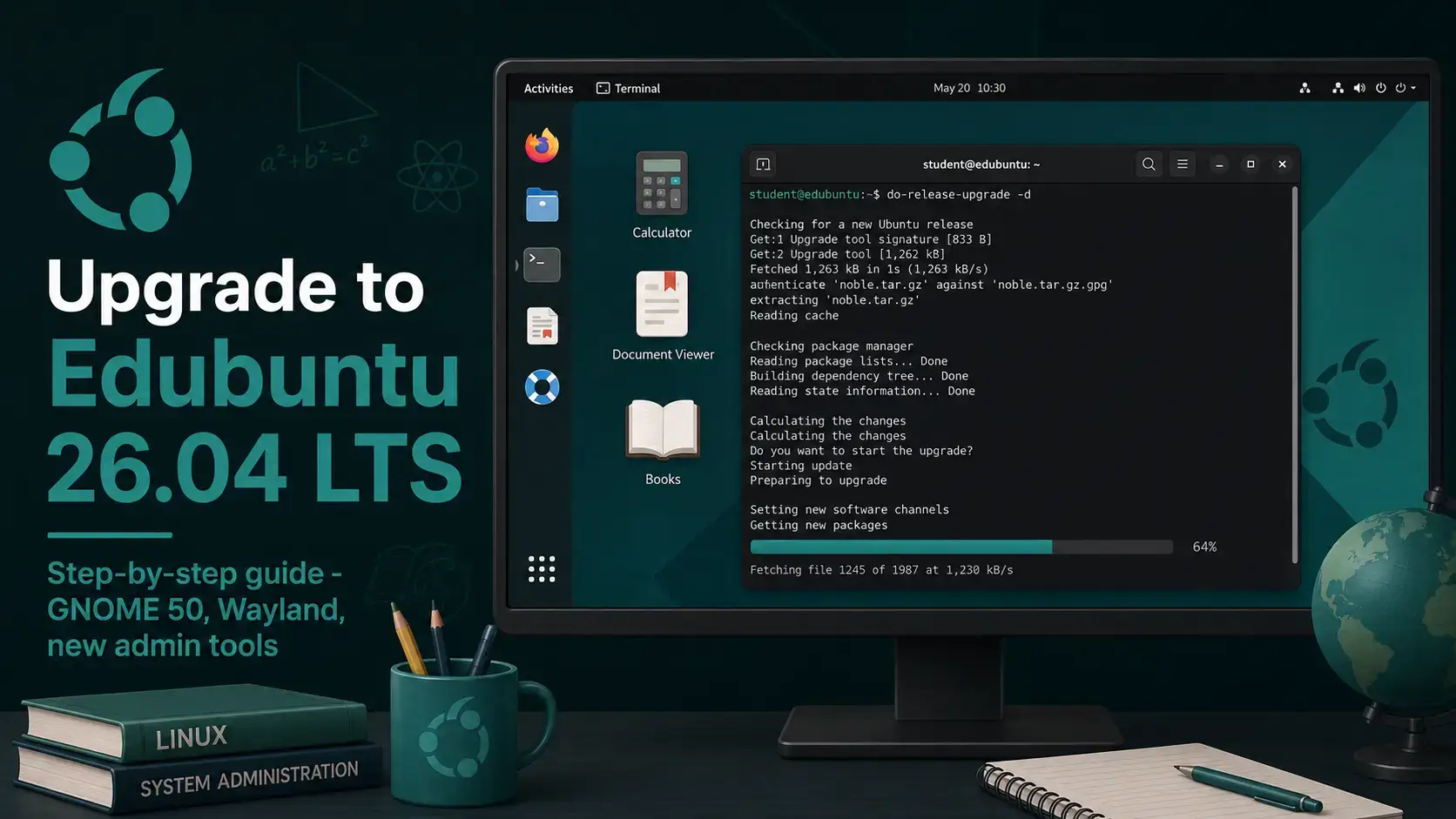

The complete step-by-step guide for upgrading from Edubuntu 24.04 LTS to 26.04 LTS. Covers GNOME config backup, the rewritten Edubuntu admin tools, the switch to Wayland, the do-release-upgrade process, and what to check after the upgrade finishes.
edubuntu-desktop before upgrading to ensure all Edubuntu components upgrade correctly-d flag until thenThe Biggest Change: Wayland Is Now the Only GNOME Session
If you are upgrading from Edubuntu 24.04, the most significant change you will notice after the upgrade is the session itself. Edubuntu 24.04 ran GNOME on X11 by default. Edubuntu 26.04 runs GNOME 50 on Wayland only. The X11 GNOME session option has been removed – GNOME Shell no longer supports running as an X.org session.
For most users in educational settings, this change is invisible. Standard educational software, browsers, LibreOffice, and GNOME applications all work correctly on Wayland. Applications that were built for X11 continue to run through the XWayland compatibility layer, which handles translation between the two protocols transparently.
Where this matters is in tools that specifically interact with the display server directly – certain screen recorders, remote desktop tools, or older administrative software that hooks into X11 internals. If your school environment uses any of those tools, test them on a single machine before rolling the upgrade out broadly.
The Other Big Change: Admin Tools Rewritten from Scratch
The Edubuntu Installer and Menu Administration tools have been completely rewritten in Python for 26.04. The previous shell-based implementation has been replaced. This matters for any school or classroom that had age-group profiles, menu restrictions, or Cockpit configurations set up on Edubuntu 24.04.
The new tools offer the same core functionality – age-group profile assignment, per-user application menu control, terminal keyboard shortcut restrictions for students – but they do not import settings from the old shell-based tools. Any profiles you set up previously will need to be reapplied through the new tools after upgrading. The new tools are more capable: they now support a GTK4 or Qt6 interface (auto-detected based on your session), Cockpit web-based remote administration, and per-user configuration overrides alongside system-wide defaults.
Plan time after the upgrade to walk back through your classroom profiles. It is worth doing deliberately rather than assuming the old settings carried over.
Which Upgrade Path Applies to You?
Not every Edubuntu version can upgrade directly to 26.04. The table below shows the supported paths. If your current version is not listed as a direct source, follow the step column first. If you would prefer a clean install over an in-place upgrade, the Edubuntu 26.04 download page has the official ISO link and verification steps.
| Current Version | Direct to 26.04? | What to Do |
|---|---|---|
| Edubuntu 24.04 LTS | Yes | Follow this guide directly |
| Edubuntu 25.10 | Yes | Follow this guide directly – use -d flag until 26.04.1 ships |
| Edubuntu 22.04 LTS | No | Upgrade to 24.04 first, then follow this guide |
| Edubuntu 23.10 / 25.04 (EOL) | No | These releases are end-of-life. Fresh install of 26.04 recommended |
| Edubuntu 20.04 LTS or older | No | Upgrade through each LTS in sequence, or do a fresh install |
Before You Upgrade – 5 Steps
Do not skip this section. Edubuntu has two upgrade-specific considerations that do not appear in a generic Ubuntu upgrade guide: the GNOME configuration backup and the Edubuntu admin tools. A few minutes here can prevent a frustrating recovery session later.
The upgrade preserves your home directory, but hardware failures and power cuts do not care about timing. Back up anything important before starting. A full system snapshot is ideal if you are on a virtual machine or school server.
Upgrading from GNOME 46 on X11 to GNOME 50 on Wayland can cause some settings and extensions to behave differently on first login. Run both commands before starting:
dconf dump /org/gnome/ > ~/gnome-dconf-$(date +%Y%m%d).txt
The first backs up per-application GNOME config folders. The second exports your GNOME desktop settings from dconf. If anything looks wrong after the upgrade, you can restore from these files.
If you have age-group profiles or classroom menu configurations set up via the Edubuntu Installer or Menu Administration tool, write them down now. These settings do not migrate automatically to the new Python-based tools. You will need to reapply them after the upgrade. Note which users have which profiles, any menu restrictions in place, and any terminal shortcut settings for student accounts.
The edubuntu-desktop meta-package ensures all required Edubuntu components are present before the upgrade tool runs. If it is missing or was partially removed at some point, the upgrade may not correctly install the new Python-based admin tools or other Edubuntu-specific packages.
The upgrade tool will refuse to run if your system has pending updates. Run all four commands and reboot if the kernel was updated before continuing.
sudo apt upgrade
sudo apt dist-upgrade
sudo apt autoremove
How to Upgrade via Terminal
This is the recommended method. It works on any Edubuntu system and gives you the most visibility into what the upgrade is doing.
Make sure the Edubuntu desktop meta-package is present before proceeding. This command installs it if missing and confirms it if already installed.
The update-manager-core package provides the do-release-upgrade command. It is usually already installed on Edubuntu 24.04, but this confirms it.
Because the automatic LTS-to-LTS upgrade prompt is not yet enabled (it activates with 26.04.1 in August 2026), use the -d flag. This tells the tool to fetch the newly available release directly. Edubuntu 26.04 is a full production release – the -d flag does not mean unstable.
After 26.04.1 ships in August 2026, you can drop the -d flag and run sudo do-release-upgrade on its own.
The tool walks you through a series of prompts. Here is what to expect at each stage:
The tool checks for blockers, then shows a summary: how many packages will be upgraded, installed, and removed. Read this. If anything looks unexpected, press N to cancel and investigate before continuing. A removal count that includes Edubuntu-specific packages from 24.04 is expected – these are being replaced by the new 26.04 versions.
The tool downloads all required packages. The terminal shows a progress bar. Do not close the terminal or interrupt this process.
For system configuration files you have previously modified, the tool asks whether to keep your version or install the package maintainer’s version. If you have not customized the file, choose the maintainer’s version. If you have, keep yours and compare the two manually after the upgrade.
Near the end of the process, the upgrade tool will ask you to close open applications and will terminate the GNOME session to replace desktop components. Once all packages are installed, it prompts for a full system reboot. Choose yes – the system reboots into Edubuntu 26.04 on Wayland.
When you run sudo do-release-upgrade -d on a remote system over SSH, the tool automatically opens a secondary SSH port (default: 1022) as a fallback in case your main connection drops during the upgrade. Before starting, open port 1022 through your firewall. If you use UFW: sudo ufw allow 1022/tcp. The tool will remind you and wait for confirmation before continuing.
Managing a lab or multi-machine classroom? Run the upgrade on one machine first and verify it fully before rolling out to others. Once you have confirmed everything works – especially the rewritten Edubuntu Installer and Menu Administration tools – use the new Cockpit web administration module (installed with Edubuntu 26.04) to reapply age-group profiles and classroom settings across your network from a single browser interface, rather than logging into each machine individually. Access it at https://[machine-ip]:9090 after enabling the Cockpit service: sudo systemctl enable --now cockpit.socket.
A clean install gives you a fresh GNOME 50 setup with no leftover configuration from older releases. Get the official ISO directly – AMD64 desktop or Raspberry Pi preinstalled image.
How to Upgrade via Software Updater (Desktop Only)
The graphical upgrade path uses Software Updater. There is one important caveat: Software Updater will not show a 26.04 upgrade prompt until Edubuntu 26.04.1 ships in August 2026. Until then, you need to launch it with a flag that tells it to check for newly available releases. Before using this method, still complete the five pre-upgrade steps above.
Software Updater opens and begins checking for updates. After applying any pending updates, it will show a banner: “Edubuntu 26.04 LTS is now available.” Click Upgrade to begin. The GUI walks you through the same process as the terminal method with a visual progress bar and dialog boxes for configuration decisions. Total time: 45-70 minutes.
When the upgrade finishes, Software Updater will ask you to restart. Click Restart Now. Your system reboots into Edubuntu 26.04 with GNOME 50 on Wayland.
After the Upgrade – What to Check
Once the system reboots into Edubuntu 26.04, run through these checks. Several of them are specific to Edubuntu and will not appear in a generic Ubuntu upgrade guide.
Should show Ubuntu 26.04 LTS and codename resolute.
Should return wayland. If it returns x11, you may have selected an older session at the login screen.
Should report a 7.x kernel version.
Open Edubuntu Installer from the application menu. The interface is new – GTK4 or Qt6 depending on your session. Work through your classroom profiles using the notes you made in Step 3 of the pre-upgrade checklist. Apply age-group metapackages, menu restrictions, and per-user settings.
sudo apt upgrade
A handful of packages often have updates available immediately after a release upgrade.
The Alphabetical App Grid extension ships with Edubuntu 26.04 updated to v44.0 for GNOME 50. Any third-party extensions you installed on 24.04 may need updates or may be incompatible with GNOME 50. Check GNOME Extensions in Settings and disable any that show errors.
Known Issues and Fixes
These are the issues most likely to affect users upgrading from Edubuntu 24.04. Most have clear solutions or workarounds.
Cause: Upgrading from GNOME 46 on X11 to GNOME 50 on Wayland changes some session defaults. Settings that were stored in X11-specific config paths may not carry over. GNOME Shell extensions that were X11-only will be automatically disabled.
Fix: If you backed up your dconf settings before upgrading (Step 2 above), you can restore your GNOME settings:
Replace YYYYMMDD with the date in your backup filename. Note that some settings valid under GNOME 46 may not apply under GNOME 50 – load the backup and then check Settings to confirm everything looks correct.
Cause: The Edubuntu Installer and Menu Administration tools were completely rewritten in Python for 26.04. The old shell-based tool configurations are not read by the new tools. This is expected behavior, not a bug.
Fix: Open the new Edubuntu Installer from the application menu and reapply your age-group metapackages for each user. Then open Edubuntu Menu Administration to restore any menu restrictions and terminal shortcut settings. The new tools offer more options than the old ones – including per-user overrides and the Cockpit web admin module for remote classroom management.
Cause: Some screen recording and remote desktop tools built for X11 do not work correctly under a Wayland session, or require Wayland-specific configuration to enable screen capture permissions.
Fix: For screen recording, check whether the app supports the Wayland PipeWire screen capture portal. Tools like OBS Studio 30+ and GNOME’s built-in screen recorder work correctly on Wayland. For remote desktop access, GNOME 50 includes an improved remote desktop solution with hardware acceleration – enable it in Settings > System > Remote Desktop. If you rely on VNC-based tools, those may need to be replaced with a Wayland-compatible alternative.
Cause: The Ubuntu welcome app branding does not yet match Edubuntu in 26.04. This is a known issue acknowledged by the Edubuntu team and is cosmetic only. It does not affect any functionality.
What to do: Nothing – the Edubuntu team is working on a resolution. You can close the welcome app and ignore it. All other Edubuntu branding, tools, and packages are correctly installed.
Cause: The upgrade tool disables third-party PPAs during the upgrade to prevent conflicts. They are not deleted, just disabled. Some may also not yet have packages built for Ubuntu 26.04.
Fix: Open Software & Updates, go to the Other Software tab, and re-enable the PPAs you need. Run sudo apt update after re-enabling each one. If a PPA fails to fetch, check whether the maintainer has released a 26.04-compatible version yet.
If the upgrade is interrupted – by a power cut, a dropped SSH connection, or a package error – do not panic and do not try to reboot straight away. Open a terminal and run these two commands in order. They repair packages left in a half-installed state and resolve broken dependencies.
sudo apt install -f
Once both commands complete without errors, run the upgrade command again. The tool will pick up where it left off rather than starting from scratch.
Frequently Asked Questions
Can I upgrade directly from Edubuntu 22.04 to 26.04?
No. Edubuntu follows the same LTS upgrade path as Ubuntu. You cannot skip releases. You must first upgrade from Edubuntu 22.04 LTS to 24.04 LTS, then from 24.04 LTS to 26.04 LTS. Run sudo do-release-upgrade on your 22.04 system first to reach 24.04, then repeat the process.
Why does do-release-upgrade say no new release found on my Edubuntu 24.04 system?
This is expected. The automatic LTS-to-LTS upgrade prompt is not enabled until the first point release, which for 26.04 is planned for around August 2026. To upgrade before then, run sudo do-release-upgrade -d to access the release directly. The -d flag means development or newly released, not unstable. Edubuntu 26.04 is a full production release.
Does Edubuntu 26.04 switch to Wayland after the upgrade?
Yes. After upgrading, your GNOME session will run on Wayland only. The X11 GNOME session has been removed because GNOME Shell no longer supports it. Applications that depend on X11 continue to work through the XWayland compatibility layer, so most educational software and general applications are unaffected. Tools that hook directly into the X11 display server may need to be replaced with Wayland-compatible versions.
What happens to my age-group profiles and Edubuntu Installer settings after the upgrade?
The Edubuntu Installer and Menu Administration tools have been completely rewritten in Python for 26.04, replacing the previous shell-based tools. Any age-group profiles or classroom menu configurations you set up with the old tools will need to be reapplied using the new Python tools after the upgrade. The new tools offer the same functionality with an improved interface and additional options – including per-user overrides and a Cockpit web admin module. Settings do not migrate automatically, so note down your current configuration before upgrading.
What GNOME configuration files should I back up before upgrading?
Back up two things. The ~/.config/gnome-* folders hold per-application GNOME config. The dconf database at /org/gnome/ stores your desktop settings. Run tar -czf ~/gnome-config-backup-$(date +%Y%m%d).tar.gz ~/.config/gnome-* and dconf dump /org/gnome/ > ~/gnome-dconf-$(date +%Y%m%d).txt before upgrading. Both commands are in the pre-upgrade checklist section of this guide.
What is the edubuntu-desktop meta-package and why does it matter?
edubuntu-desktop is the meta-package that pulls in the complete set of Edubuntu desktop components, including the Edubuntu Installer and Menu Administration tools. Making sure it is installed before running the upgrade ensures the upgrade tool correctly installs all required 26.04 Edubuntu packages, especially the new Python-based admin tools. If it was partially removed at some point, some Edubuntu-specific tools may not upgrade correctly. Run sudo apt install edubuntu-desktop before starting.
How long does the upgrade from Edubuntu 24.04 to 26.04 take?
On a typical broadband connection, the full upgrade takes between 45 and 70 minutes including the download, package installation, and reboot. The process is largely unattended after the initial prompts, so you can leave it running. After the upgrade, allow additional time to reapply your Edubuntu age-group profiles and classroom configurations through the new admin tools.
More Edubuntu 26.04 guides: Edubuntu 26.04 ISO Download · What’s New in Edubuntu 26.04 · Edubuntu 26.04 Wallpapers