


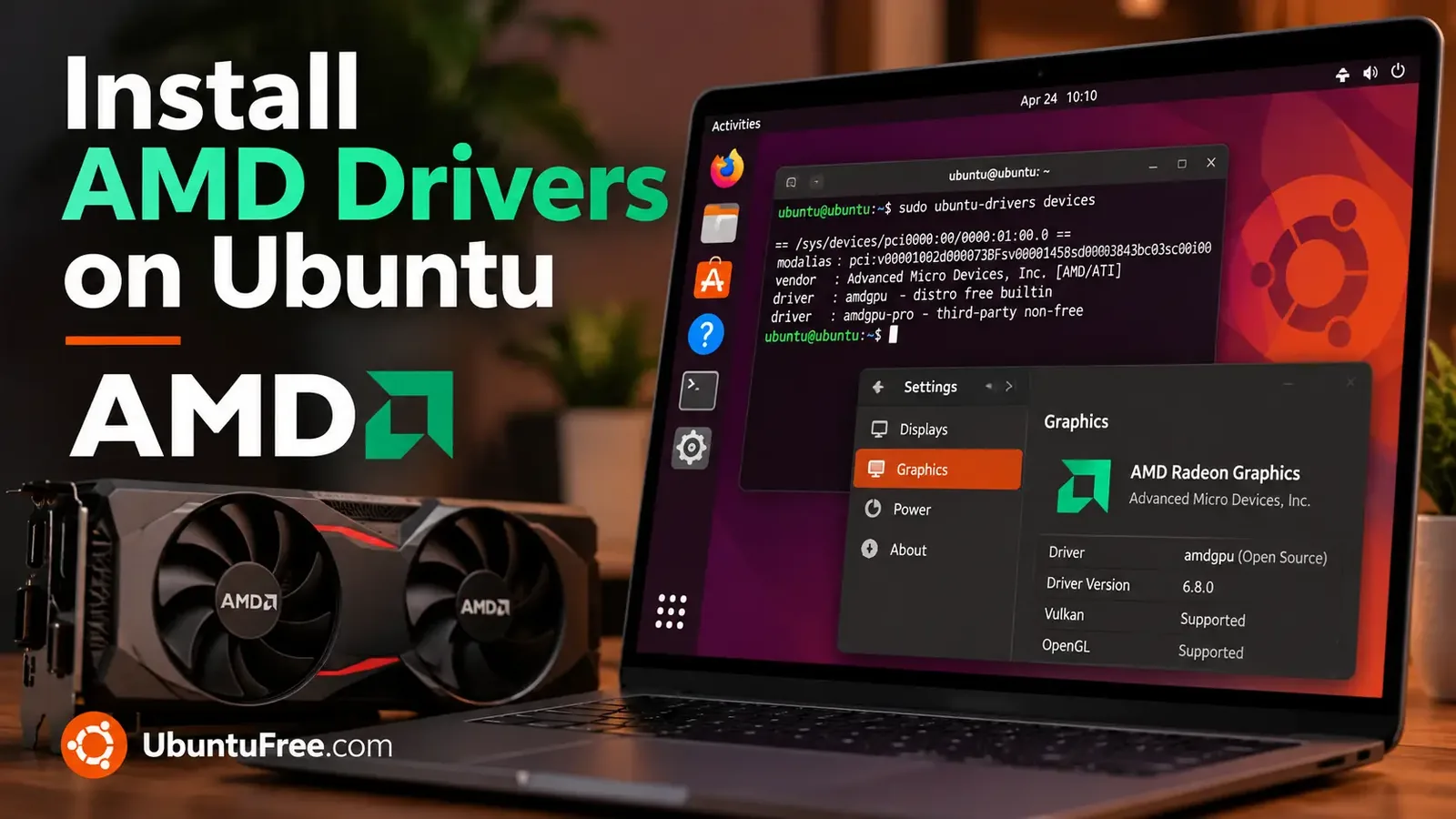
To install AMD drivers on Ubuntu 26.04, run sudo apt update && sudo apt full-upgrade and reboot. The AMD driver is already built into Ubuntu, so there is nothing to download. Updating brings the newest version of the kernel driver, OpenGL and Vulkan, and hardware video decoding.
Below: how to confirm your card is using it, the apps that replace AMD’s Windows control panel, and ROCm for AI work. The fixes cover a card stuck on software rendering and older Radeon cards. If something does not work, leave a comment or contact us and we will help you fix it.
Install AMD Drivers in 3 Steps
Open a terminal with Ctrl + Alt + T. This works the same for Radeon graphics cards and the graphics built into Ryzen processors.
Update Ubuntu and reboot
sudo apt update && sudo apt full-upgradesudo rebootAMD driver updates reach Ubuntu this way, with the kernel, Mesa and firmware. Keep installing updates and the driver stays current.
Check that the card uses the amdgpu driver
lspci -k | grep -EA3 'VGA|3D|Display'mike@ubuntu:~$ lspci -k | grep -EA3 'VGA|3D|Display'
03:00.0 VGA compatible controller: Advanced Micro Devices, Inc. [AMD/ATI] Navi 32 [Radeon RX 7700 XT / 7800 XT] (rev c8)
Subsystem: Advanced Micro Devices, Inc. [AMD/ATI] Navi 32 [Radeon RX 7700 XT / 7800 XT]
Kernel driver in use: amdgpu
Kernel modules: amdgpuKernel driver in use: amdgpu is the line that matters. A Ryzen laptop or desktop with a graphics card can show two entries, one for the graphics inside the processor. Both should say amdgpu.
If it says radeon, see older Radeon cards. If the entry names Intel instead, see how to install Intel graphics drivers on Ubuntu. If there is no driver line at all, see the first fix.
Confirm OpenGL and Vulkan use your card
The two test tools are not installed by default. Add them:
sudo apt install mesa-utils vulkan-toolsglxinfo -B | grep 'OpenGL renderer'mike@ubuntu:~$ glxinfo -B | grep 'OpenGL renderer'
OpenGL renderer string: AMD Radeon RX 7800 XT (radeonsi, navi32, ...)vulkaninfo --summary | grep -E 'deviceName|driverName'mike@ubuntu:~$ vulkaninfo --summary | grep -E 'deviceName|driverName'
deviceName = AMD Radeon RX 7800 XT (RADV NAVI32)
driverName = radv
deviceName = llvmpipe (LLVM 21.1.8, 256 bits)
driverName = llvmpipeYour card name in both means you are done. The extra llvmpipe entry in the Vulkan list is normal. It is a software fallback, and games use the real card.
If the OpenGL line says llvmpipe instead of your card, the desktop is running without the GPU. Go to the fix.
Check Hardware Video Decoding
Ubuntu 26.04 turns on hardware video decoding for AMD graphics by default. The card plays video instead of the processor, which saves power and keeps fans quiet.
Check which formats your card decodes
sudo apt install vainfo

vainfo
mike@ubuntu:~$ vainfo
vainfo: VA-API version: 1.23 (libva 2.23.0)
vainfo: Driver version: Mesa Gallium driver 26.0.8-1ubuntu0.3 for AMD Radeon RX 7800 XT (radeonsi, navi32, ...)
vainfo: Supported profile and entrypoints
VAProfileH264High : VAEntrypointVLD
VAProfileH264High : VAEntrypointEncSlice
VAProfileHEVCMain : VAEntrypointVLD
VAProfileHEVCMain : VAEntrypointEncSlice
VAProfileVP9Profile0 : VAEntrypointVLD
VAProfileAV1Profile0 : VAEntrypointVLD
VAProfileAV1Profile0 : VAEntrypointEncSliceEach VAEntrypointVLD line is a format the card decodes. VAEntrypointEncSlice means it can also encode that format, which screen recorders such as OBS Studio can use. Older cards list fewer formats.
Apps that support VA-API use it on their own. There is nothing to switch on.
AMD Control Panel Apps
AMD Software: Adrenalin Edition is Windows only. On Ubuntu, these apps from the standard repositories cover the same ground.
| App | What it does | Install |
|---|---|---|
| CoreCtrl | Fan curves and power profiles, in a window | sudo apt install corectrl |
| radeontop | Live GPU load and video memory use in the terminal | sudo apt install radeontop |
| nvtop | GPU load graphs and the apps using the card, in the terminal. Works on AMD despite the name | sudo apt install nvtop |
ROCm for AI and Compute
ROCm is AMD’s toolkit for running compute and AI work on the graphics card, the AMD answer to CUDA. Games and the desktop do not use it.
Using Ollama or LM Studio? You do not need ROCm
Both bring their own copy. The Ollama installer detects an AMD card and downloads what it needs, and LM Studio ships its own ROCm and Vulkan engines. Install them and they use the card.
Install ROCm from Ubuntu when you build software with it, or run a tool that asks for a system copy.
Give your account access to the GPU
ROCm talks to the card through a device only the render group can open. Add yourself, then log out and back in:
sudo usermod -aG render $USERInstall ROCm
sudo apt install rocm-devThis is the developer set: the HIP compiler, the maths and AI libraries, and the tools below. It needs about 3 GB of disk space. sudo apt install rocm adds AMD’s test suites on top and needs about 7 GB.
Check that ROCm sees the card
rocminfo | grep -E 'Marketing Name|gfx'mike@ubuntu:~$ rocminfo | grep -E 'Marketing Name|gfx'
Marketing Name: AMD Ryzen 7 7700X 8-Core Processor
Name: gfx1101
Marketing Name: AMD Radeon RX 7800 XT
Name: amdgcn-amd-amdhsa--gfx1101Your card and a gfx code mean ROCm is working. The processor always appears in the list too.
Ubuntu lists these cards for its ROCm packages:
| Card | Code in rocminfo |
|---|---|
| Radeon RX 9070 series, Radeon AI PRO R9700 | gfx1201 |
| Radeon RX 9060 series | gfx1200 |
| Radeon RX 7900 series | gfx1100 |
| Radeon RX 7700 and 7800 series | gfx1101 |
| Radeon RX 6800 and 6900 series | gfx1030 |
| Ryzen AI MAX 300 series | gfx1151 |
Other recent Radeon cards may work but are not on the list. If a tool rejects your card, check its own documentation before changing anything system-wide.
If Something Goes Wrong
The desktop uses llvmpipe instead of your card
llvmpipe is software drawing on the processor. The desktop works but feels slow and games will not run. Two causes cover almost every case. First, check the boot options:
cat /proc/cmdlineIf you see nomodeset, the graphics driver is being switched off at boot, usually by an old fix that was never undone. Open the boot settings, delete nomodeset from the GRUB_CMDLINE_LINUX_DEFAULT line, save with Ctrl + O, exit with Ctrl + X, and apply:
sudo nano /etc/default/grub

sudo update-grub

sudo reboot
If there is no nomodeset, look for a missing firmware file:
sudo dmesg | grep -i amdgpu | grep -i firmwareA line that says a firmware file failed to load means the package is damaged or incomplete. Reinstall it and reboot:
sudo apt install --reinstall linux-firmware-amd-graphics

sudo rebootAn older Radeon card uses the radeon driver
Radeon HD 7700 to 7900, R7 and R9 200 series and other cards of that generation now use the amdgpu driver by default. That gives them Vulkan, which Steam needs for most Windows games, and better speed.
If lspci -k still shows radeon for one of these cards, an older guide probably forced it. Look for leftover settings:
grep -rE 'si_support|cik_support' /etc/default/grub /etc/modprobe.d/Delete every line or boot option it finds. For a result in /etc/default/grub, edit it as in the fix above and run sudo update-grub. For a file in /etc/modprobe.d/, remove the line, then run sudo update-initramfs -u and reboot.
Cards older than that, such as the Radeon HD 6000 series and the low-end HD 7000 models built on the same design, stay on the radeon driver. The desktop works, but there is no Vulkan.
rocminfo says permission denied or no GPU found
Your account is not in the render group yet, or you have not logged out since joining it. Check:
groupsIf render is missing, run sudo usermod -aG render $USER. Either way, log out completely and back in, then run rocminfo again.
The screen is black after installing AMD’s driver
Restart and open the boot menu: hold Shift as the machine starts, or tap Esc on most newer PCs. Choose Advanced options, then a recovery mode entry, then root. Remove AMD’s packages and restart:
mount -o remount,rw /

apt purge amdgpu-dkms amdgpu-dkms-firmware amdgpu-install

update-initramfs -u

reboot
Ubuntu comes back on its own amdgpu driver.
AMD’s Own Driver (amdgpu-install)
AMD publishes an installer called amdgpu-install. On Ubuntu 26.04, you almost certainly do not need it.
What it adds, and what it costs
For Ubuntu 26.04, it installs one thing: AMD’s own build of the amdgpu kernel driver, compiled on your machine. It adds no control panel, no gaming speed and no ROCm. Ubuntu already includes the driver, signed and tested with its kernel.
The cost is real. With Secure Boot on, you have to enrol a key at the next boot, and the driver is rebuilt after every kernel update. When a rebuild fails, the result is often a black screen.
It mainly serves AMD Instinct servers and software that needs AMD’s exact driver version. For a desktop or laptop, stay with Ubuntu’s.
Remove AMD’s driver
sudo apt purge amdgpu-dkms amdgpu-dkms-firmware amdgpu-install

sudo update-initramfs -u

sudo apt update

sudo reboot
After the reboot, lspci -k still shows amdgpu, now Ubuntu’s own. If the screen is black instead, use the recovery steps.
Helpful Resources
Frequently Asked Questions
Do I need to install AMD drivers on Ubuntu 26.04?
No. The AMD driver is built into Ubuntu and works as soon as it is installed. Run sudo apt update && sudo apt full-upgrade and reboot to get the newest version.
Is there AMD Software: Adrenalin Edition for Ubuntu?
No, it is Windows only. CoreCtrl from the Ubuntu repositories covers fan curves and power profiles, and radeontop or nvtop show live GPU load.
Do AMD drivers work with Secure Boot on Ubuntu?
Yes. The amdgpu driver is part of Ubuntu's signed kernel, so there is nothing to enrol. Only AMD's own amdgpu-install driver asks for a key at boot.
Does my old Radeon HD 7000 card work on Ubuntu 26.04?
Radeon HD 7700 to 7900, R7 and R9 200 cards now use the amdgpu driver, with Vulkan. Older models such as the HD 6000 series use the radeon driver, which runs the desktop but has no Vulkan.
Do I need ROCm to run Ollama on an AMD GPU?
No. The Ollama installer downloads its own ROCm libraries when it finds an AMD card. LM Studio also ships its own. Install ROCm from Ubuntu only for development work.
How do I check which AMD driver I am using?
Run lspci -k in a terminal. The graphics card entry shows Kernel driver in use: amdgpu, or radeon on older cards. glxinfo -B shows the Mesa version.
Play your Windows games through Steam, then finish setting up the rest of Ubuntu.
More Ubuntu guides: Install NVIDIA Drivers on Ubuntu · Install Intel Graphics Drivers on Ubuntu · Upgrade to Ubuntu 26.04 · Best Linux Distros for Gaming · GeForce NOW on Linux