

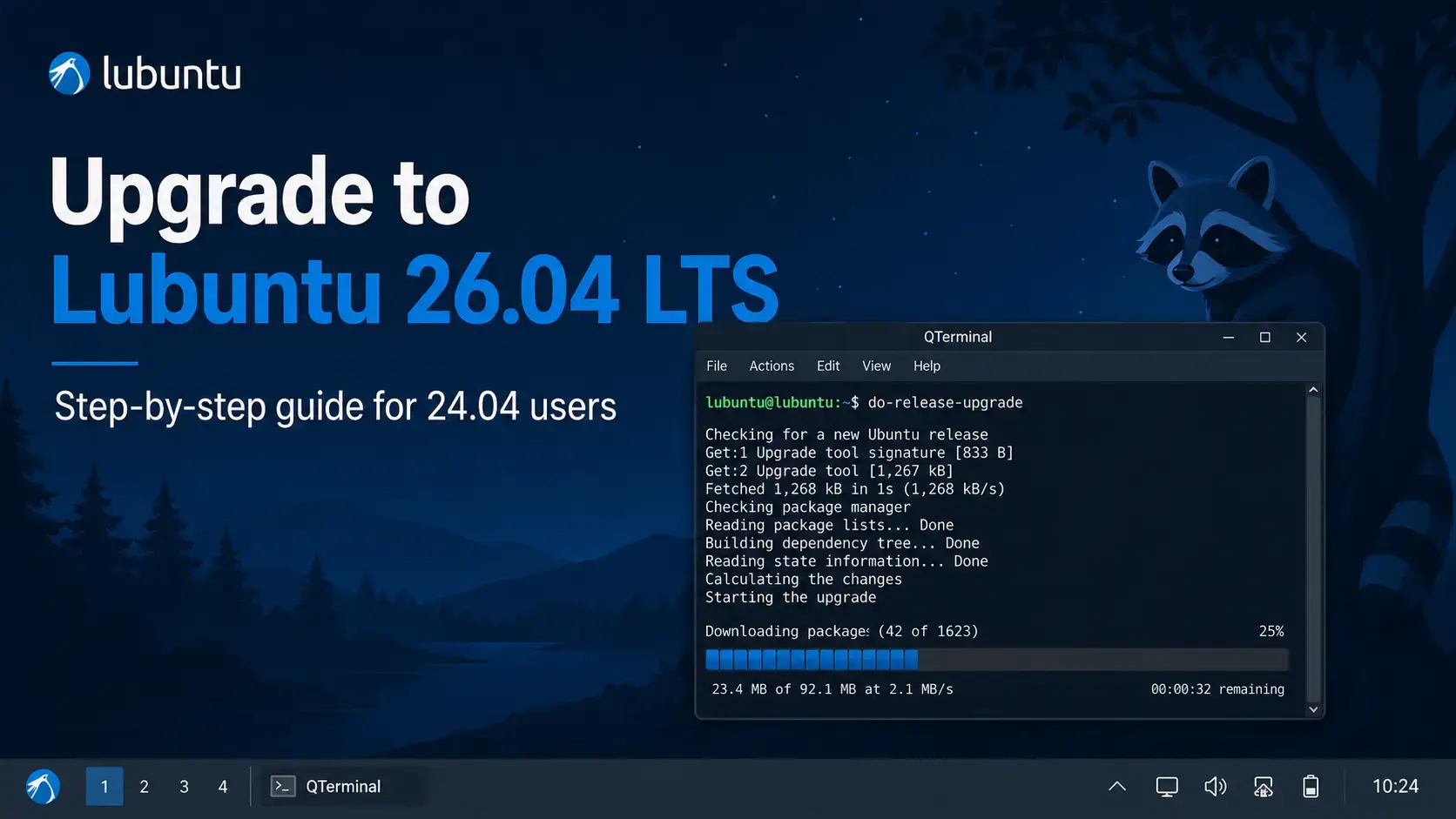

The complete step-by-step guide for upgrading from Lubuntu 24.04 LTS to 26.04 LTS. Covers terminal and GUI methods, LXQt configuration backup, Rust coreutils compatibility, and what to do after the upgrade finishes.
-d flag until thenWhy Upgrade to Lubuntu 26.04?
If you are on Lubuntu 24.04 and things are working, the case for upgrading is clear. Lubuntu 26.04 ships LXQt 2.3 with the new Fancy Menu launcher – a noticeably more polished application launcher that replaces the older LXQt menu – and Kvantum as the new theming engine, which means Qt 6 applications look consistently styled for the first time in an LTS release. Those two changes are the most visible things you will notice on first login. Under the hood, you get Linux kernel 7.0 – a large jump from the 6.8 kernel in Lubuntu 24.04 – with improved hardware support, the NTSYNC driver for better gaming performance, and updated Wi-Fi and Bluetooth firmware. The default session remains X11; Wayland is available but opt-in only. You also reset your support clock: Lubuntu 26.04 LTS is supported until April 2029, giving you three full years from a clean baseline. Lubuntu 24.04 reaches end of life at the same date, so upgrading now rather than later costs you nothing in support time. For the full feature breakdown, see What’s New in Lubuntu 26.04.
Which Upgrade Path Applies to You?
Not every Lubuntu version can upgrade directly to 26.04. The table below shows the supported paths. If your current version is not listed as a direct source, follow the step column first. If you would prefer a clean install over an in-place upgrade, the Lubuntu 26.04 download page has the official ISO links and SHA256 verification steps.
| Current Version | Direct to 26.04? | What to Do |
|---|---|---|
| Lubuntu 24.04 LTS | Yes | Follow this guide directly |
| Lubuntu 25.10 | Yes | Follow this guide directly |
| Lubuntu 22.04 LTS | No | Upgrade to 24.04 first, then to 26.04 |
| Lubuntu 23.10 / 25.04 (EOL) | No | These releases are end-of-life. Fresh install of 26.04 recommended |
| Lubuntu 20.04 LTS or older | No | Upgrade through each LTS in sequence, or do a fresh install |
Before You Upgrade – 5 Steps
Do not skip this section. These steps take less than 10 minutes and prevent the majority of issues that users run into during and after the Lubuntu upgrade. Steps 2 and 3 are specific to LXQt and Rust – pay attention to both if you are coming from 24.04.
The upgrade preserves your home directory, but hardware failures and power cuts do not care about timing. Back up anything important before starting. A full system snapshot is ideal if you are on a virtual machine.
This is the most important Lubuntu-specific step. LXQt stores your panel layout, app settings, and keyboard shortcuts in ~/.config. Config files from LXQt 1.x (Lubuntu 24.04) can cause visual problems or a broken panel on first login after upgrading to LXQt 2.3. Create a backup now:
After the upgrade completes but before your first login, you will need to remove ~/.config so LXQt regenerates a clean 26.04 config. The exact steps are in the Post-Upgrade section below.
Lubuntu 26.04 is the first Ubuntu LTS to ship Rust-based coreutils and sudo-rs as defaults. Most standard scripts will work without any changes. However, if you maintain scripts that rely on specific GNU coreutils behavior or non-standard sudo features, test them before upgrading a production system.
GNU versions remain available: prefix any command with gnu- to call the GNU original (e.g. gnu-ls). If you rely on LDAP authentication or advanced sudoers directives, the original sudo is still available as the sudo-ws package.
The upgrade tool will refuse to run if your system has pending updates. Run all four commands and reboot if the kernel was updated.
sudo apt upgrade
sudo apt dist-upgrade
sudo apt autoremove
Lubuntu 26.04 switches from Breeze to Kvantum as the default theming engine. Most apps will look better after the upgrade because Qt 6 applications are now themed correctly for the first time in an LTS release. However, if you have manually applied custom LXQt themes or have third-party Qt apps that reference Breeze explicitly, check whether they will need reconfiguring after the upgrade. This is an uncommon scenario but worth a quick check if you have a heavily customized desktop.
How to Upgrade via Terminal
This is the recommended method. It works for both Desktop and any headless Lubuntu system. The official Lubuntu upgrade documentation documents this as the primary upgrade path, and it gives you the most control over what happens during the process.
The update-manager-core package provides the do-release-upgrade command. It is usually already installed on Lubuntu 24.04, but this confirms it.
Because the automatic LTS-to-LTS upgrade prompt is not yet enabled (it activates with 26.04.1 in August 2026), use the -d flag. This tells the tool to fetch the newly available release directly. Lubuntu 26.04 is a full production release – the -d flag does not mean unstable.
After 26.04.1 ships in August 2026, you can drop the -d flag and run sudo do-release-upgrade on its own.
The tool walks you through a series of prompts. Here is what to expect at each stage:
The tool checks for blockers, then shows a summary: how many packages will be upgraded, installed, and removed. Read this. If anything looks unexpected, press N to cancel and investigate before continuing. You can press D to see the full list of changes before committing.
The tool downloads all required packages. Lubuntu is one of the smaller Ubuntu flavors, so this step tends to be faster than a full Ubuntu or Kubuntu upgrade. Do not close the terminal or interrupt this process.
For system configuration files you have previously modified, the tool asks whether to keep your version or install the package maintainer’s version. If you have not customized the file, choose the maintainer’s version. If you have, keep yours and compare them manually after the upgrade.
Once all packages are installed, the tool asks if you want to restart. Choose yes – but do not log in to the LXQt desktop yet. See the “After the Upgrade” section first for the required config reset step.
When you run sudo do-release-upgrade -d on a remote Lubuntu system over SSH, the tool automatically opens a secondary SSH port (default: 1022) as a fallback in case your main connection drops. Before starting, open port 1022 through your firewall. If you use UFW: sudo ufw allow 1022/tcp. The tool will remind you and wait for confirmation before continuing.
A clean install gives you a fresh LXQt 2.3 setup with no leftover configuration from older releases. Get the official ISO directly.
How to Upgrade via the Graphical Updater (Desktop Only)
Lubuntu includes a graphical upgrade path through the same Software Updater backend used across Ubuntu flavors. There is one important caveat: Software Updater will not show a 26.04 upgrade prompt until Lubuntu 26.04.1 ships in August 2026. Until then, you need to launch it with a flag that tells it to check for newly available releases.
Software Updater opens and begins checking for updates. After applying any pending updates, it will show a banner: “Lubuntu 26.04 LTS is now available.” Click Upgrade to begin. The GUI walks you through the same process as the terminal method – with a visual progress bar and dialog boxes for configuration decisions. Total time: 30-50 minutes.
When the upgrade finishes, Software Updater will ask you to restart. Click Restart Now – but before you log in to the LXQt desktop, complete the config reset step in the next section.
After the Upgrade – What to Do First
This section contains one step that is specific to Lubuntu and easy to miss. Do not skip it. After that, the remaining checks are standard post-upgrade verification.
After the system reboots into Lubuntu 26.04, do not log in to the desktop yet. Switch to a virtual terminal first by pressing Ctrl+Alt+F2 and logging in with your username and password. Then remove the old LXQt config directory:
This removes your old LXQt 1.x config. LXQt 2.3 will regenerate a clean set of default config files on your first login. Your backup is safely in ~/.config-backup-24.04 from Step 2 of the pre-upgrade checklist.
Once that is done, return to the graphical login screen by pressing Ctrl+Alt+F7 (or Ctrl+Alt+F1 on some systems) and log in normally.
The output should show Ubuntu 26.04 LTS and codename resolute.
Should report LXQt 2.3.x. You can also check via Preferences – LXQt Settings – About LXQt.
Should report a 7.x kernel version.
sudo apt upgrade
A handful of packages often have updates available immediately after a release upgrade.
Known Issues and Fixes
These are the issues most likely to affect users upgrading from Lubuntu 24.04. All have clear solutions or easy workarounds.
Cause: Old LXQt 1.x configuration files from Lubuntu 24.04 conflict with LXQt 2.3’s updated component structure. The panel may appear empty, widgets may fail to load, or the desktop may look different from how you left it.
Fix: This is why the config reset step above exists. If you already logged in before doing it, open QTerminal and remove the config directory now: rm -rf ~/.config – then log out and back in. LXQt will rebuild the desktop from fresh defaults. Your backup at ~/.config-backup-24.04 lets you retrieve any specific settings you want to carry over.
Cause: KWallet and KWalletManager are installed by default in Lubuntu 26.04 instead of gnome-keyring. This is a known packaging issue being tracked by the Lubuntu team. KWallet is a KDE credential manager and is not part of the intended default app set for Lubuntu.
Fix: If you do not use KWallet, remove it after the upgrade. It will not affect desktop functionality:
Cause: Alacritty is installed alongside QTerminal in Lubuntu 26.04. This is a known issue. QTerminal remains the primary and default terminal emulator. Alacritty is an extra that most Lubuntu users do not need and did not ask for.
Fix: Remove it if you prefer a single terminal:
Cause: The upgrade tool disables third-party PPAs during the upgrade to prevent conflicts. They are not deleted, just disabled. Some may also not yet have packages built for Ubuntu 26.04.
Fix: Open Software Sources from the Preferences menu, go to the Other Software tab, and re-enable the PPAs you need. Run sudo apt update after. If a PPA fails, check whether the maintainer has released a 26.04-compatible version yet.
If the upgrade is interrupted – by a power cut, a dropped SSH connection, or a package error – do not panic and do not try to reboot straight away. Open a terminal and run these two commands in order. They repair packages left in a half-installed state and resolve broken dependencies.
sudo apt install -f
Once both commands complete without errors, run the upgrade command again. The tool will pick up where it left off rather than starting from scratch.
Frequently Asked Questions
Can I upgrade directly from Lubuntu 22.04 to 26.04?
No. Lubuntu follows the same LTS upgrade path as Ubuntu. You cannot skip LTS releases. You must first upgrade from Lubuntu 22.04 LTS to 24.04 LTS, then from 24.04 LTS to 26.04 LTS. Run sudo do-release-upgrade on your 22.04 system to reach 24.04, then repeat the process from there.
Why does do-release-upgrade say no new release found on my Lubuntu 24.04 system?
This is expected right now. The automatic LTS-to-LTS upgrade prompt is not enabled until the first point release, which for 26.04 is planned for around August 2026. To upgrade before then, run sudo do-release-upgrade -d to access the release directly. The -d flag means development or newly released, not unstable. Lubuntu 26.04 is a full production release.
Do I need to back up my LXQt settings before upgrading?
Yes. LXQt stores your panel layout, application settings, themes, and keyboard shortcuts in ~/.config. Configuration files from LXQt 1.x (the version in Lubuntu 24.04) can cause visual issues or broken panels after the upgrade. Run cp -r ~/.config ~/.config-backup-24.04 before starting, then remove ~/.config before your first login on the upgraded desktop. LXQt 2.3 will regenerate a clean config automatically.
Will my shell scripts break because of the Rust coreutils in Lubuntu 26.04?
Most standard shell scripts will work without changes. Ubuntu 26.04 ships Rust-based coreutils alongside the original GNU utilities for compatibility. If a script hits a behavioral difference, the GNU versions are still available with the gnu- prefix (for example, gnu-ls). The sudo-rs replacement for sudo is also not 100% compatible with every sudo feature – if you rely on LDAP authentication or advanced sudoers directives, the original sudo is still available as the sudo-ws package.
How long does the upgrade from Lubuntu 24.04 to 26.04 take?
On a typical broadband connection, the full upgrade takes between 30 and 50 minutes including the download, package installation, and reboot. Lubuntu is a lightweight flavor with fewer packages than Ubuntu or Kubuntu, so it is generally faster. The process is unattended after the initial prompts, so you can leave it running.
What happens to KWallet after upgrading to Lubuntu 26.04?
KWallet and KWalletManager are installed by default in Lubuntu 26.04 instead of gnome-keyring. This is a known packaging issue being tracked by the Lubuntu team. KWallet will not break anything, but it is an extra package most Lubuntu users do not need. You can remove it after the upgrade with sudo apt remove kwalletmanager.
Why is Alacritty installed after upgrading to Lubuntu 26.04?
Alacritty is installed alongside QTerminal in Lubuntu 26.04. This is a known issue. QTerminal remains the primary terminal emulator. If you prefer a single terminal, remove Alacritty with sudo apt remove alacritty. This will not affect QTerminal or anything else on the desktop.
More Lubuntu 26.04 guides: Lubuntu 26.04 ISO Download · What’s New in Lubuntu 26.04 · Upgrade Guide · Lubuntu 26.04 Wallpapers